
In summary
- Cabling is the only part of the infrastructure that lasts 15 to 20 years. Everything else is replaced over and over on top of it.
- Certification is not continuity testing. It is measuring with calibrated equipment and issuing a report per socket.
- Saving on cabling is the false economy is more expensive in IT infrastructure.
- An office move is a sole opportunity of doing this well with no additional construction cost.
In this article
Cabling is the most invisible part of an IT infrastructure and the one that stays there the longest. Switches are replaced after five or six years, servers after four or five, and computers even quicker. Cabling, on the other hand, stays in the wall for fifteen or twenty years — and limits everything that comes to be installed on top of it.
Because the wiring determines everything
No equipment delivers more than the cabling allows. You can install modern switches and state-of-the-art access points: if the cable between them is old, poorly terminated or too long, performance is bottlenecked by the weakest link.
What makes this treacherous is that the wiring rarely fails cleanly. It doesn't stop working — it degrades. Intermittent slowdowns appear, patternless connection drops, slower transfers on some workstations than on others. Symptoms that are blamed on the computer, the server, the operator, and almost never the cable.
The account that matters. Cabling accounts for a small proportion of the total investment in an infrastructure, but it lasts the longest and is the most expensive to replace later—because it involves messing about with ceilings, walls and the day-to-day running of the business.
What is network certification
There is an important difference between test e certify, and that is where many proposals stand out.
Test it is to check that there is a connection between both ends — that the wires are in the right order and signal passes. It is done with a cheap device and tells you very little.
Certify it involves measuring the electrical performance of each connection using calibrated equipment, comparing the values obtained with the standard limits for the installed category. It measures attenuation, crosstalk, delay skew and other parameters that determine whether that socket will handle the promised throughput — today and ten years from now.
The result is a report by socket, with measured values and individual approval or rejection. It is this document that provides a guarantee and allows you to demand corrections.
Always demand certification with a report. An installation without certification is an installation without proof.
Which category to choose
Category choice is a time-horizon decision, not one of immediate necessity. The right question isn’t “what do I need today” — it’s “what will be going down this cable in ten years” time”.
Three practical criteria guide the decision. The expected debit over the coming years, relying on video, backups and cloud growing. The distances involved, because above certain lengths the options narrow. And the Power over Ethernet, increasingly relevant: access points, cameras and phones are powered by the network cable itself, and this requires suitable conductors.
The difference in cost between categories is mostly material. Labour — which is the dominant portion — is practically the same. Saving here saves little and limits a lot.
What a good project includes
A serious structured cabling proposal covers more than metres of cable:
- Survey and plan with the location of each socket and the route of each conveyor belt.
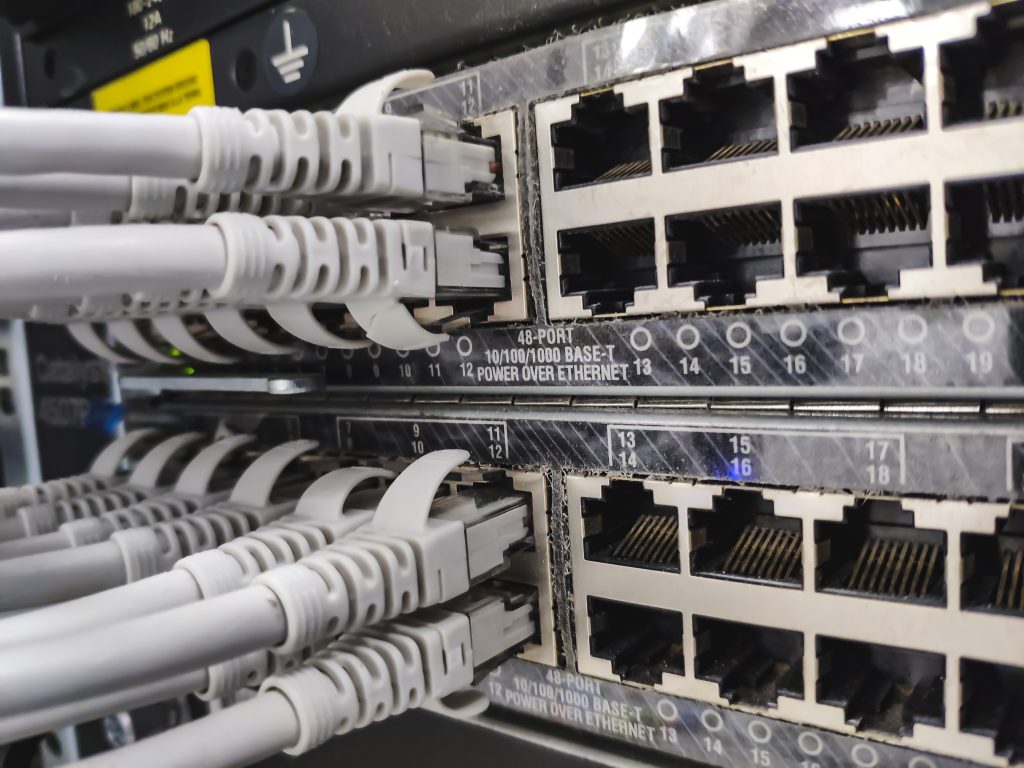
- Organised chassis — termination panels, cable management and room for growth. A well-built rack is recognised the moment you open the door.
- Identification of all sockets and cables at both ends. Without this, any future intervention starts with guesswork.
- Certification with report by phone.
- Final documentation Hand over to the client — floor plan, socket layout and reports. It is company property, not the installer's.
- Room for growth, typically 20 to 30% sockets more than current requirements. Adding them during the build is cheap; adding them afterwards is not.
Signs of poor wiring
If you recognise three or more of these symptoms, it is worth checking before investing in anything else:
- Workstations consistently slower than others, with no explanation on the computer
- Calls that drop and reconnect without an identifiable pattern
- Unidentified cables in the rack, or a rack where nobody can trace a cable from end to end
- Connections made with improvised plugs or visible splices
- Wiring installed over fifteen years ago and never certified
- New equipment that does not deliver the expected performance
And the right time to sort all this out once and for all is relocation of premises — the only time the network is rebuilt from scratch with no additional labour cost and without stopping the business.
DataRoad designs, installs and certifies structured cabling and computer networking, with outlet report and documentation handed over to the client.
A chat before making a decision
Whether you’re tackling a specific problem, planning a move or simply looking for a second opinion, we always start in the same way: by understanding your situation before making any suggestions. No obligation, no jargon and no catalogues.